
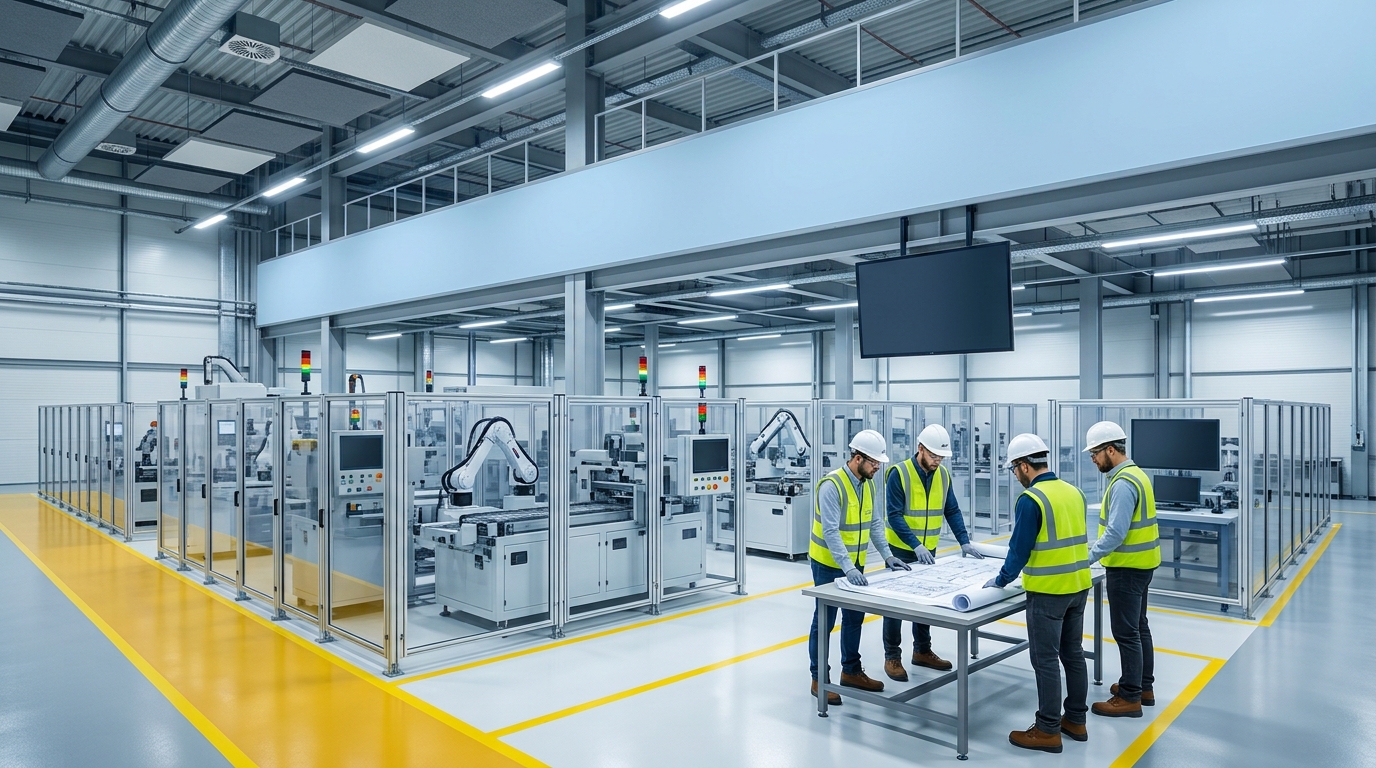
In modern production facilities and industrial factories, occupational health and safety (OHS) is not merely a legal obligation or a matter of warning signs. True workplace safety is achieved by integrating operational design (ergonomics, workflow, and machine layout) principles into the facility while it is still in the architectural and technical planning stage. A poorly planned production line, weak ventilation, or narrow transition corridors are fundamental elements that trigger human error and invite industrial accidents. In this technical guide, we examine safety-focused facility design parameters that protect employee health while increasing operational efficiency and line speed.
1. Layout Plan and Safe Traffic Flow Management
A large portion of invisible accidents occurring in a facility stem from the intersection of human traffic and material handling equipment (forklifts, AGVs, pallet jacks) routes:
-
Physically Segregated Pedestrian and Vehicle Paths: Pedestrian walkways and forklift paths must be physically separated from each other not only with yellow lines, but also with steel barriers, door-interlock systems, and sensor-guided directions.
-
Blind Spot and Corner Analyses: Blind spots in internal transport lines must be minimized, and unavoidable intersection points must be integrated with 360° convex mirrors and radar-based early warning systems.
-
Emergency Exit and Evacuation Corridors: Escape routes must be designed wide enough never to be used as temporary storage areas and must lead directly to fire doors equipped with panic bar systems.
2. Ergonomics Engineering and Prevention of Musculoskeletal Disorders
Human anatomy lies at the center of operational design. Repetitive motions and improper posture positions are the primary causes of long-term labor losses:
-
Adjustable Workstations: Benches that can be adjusted hydraulically or electromechanically in height according to the heights and reach distances of employees should be used in assembly and packaging lines.
-
Heavy Load Lifting and Support Systems: For load transfers over 15 kg, vacuum lifters, articulated arm systems (manipulators), and balancers should be put into operation to zero out the load on the employee's lower back and shoulders.
-
Glare and Lighting Ergonomics: Fixtures that prevent glare (UGR<19UGR < 19UGR<19) and provide a minimum of 500 Lux of illumination should be selected in precision assembly areas to prevent eye fatigue and the resulting loss of concentration.
3. Machine Safety Systems and EN ISO 13849 Standards
The design of production equipment must be equipped with a safety architecture that prevents injury to the operator even in the event of an incorrect move:
-
Light Curtains and Area-Scanning Sensors: Optical sensors must be used that switch the system to a safe stop (Safe Torque Off - STO) within milliseconds as soon as they detect an operator approaching a press, laser, or robot.
-
Physical Safety Cages and Switched Interlock Doors: Panels preventing access to hazardous moving parts must be supported with safety locks that cannot be opened while the machine is running.
-
LOTO (Lockout/Tagout): Stations ensuring the physical locking of energy sources (electrical, pneumatic, hydraulic) during maintenance and repair processes must be included in the operational design.
4. Industrial Hygiene, Environmental Air Conditioning, and Noise Control
The environmental conditions of the working environment directly affect the risk of work accidents and employee performance:
-
Local Extraction and Ventilation Systems: Dust and gases emerging in welding, painting, or chemical process areas must be captured at the source with local akrobat arms and exhausted outside the building through filtration.
-
Noise Isolation and Acoustic Partitioning: Noisy machines with sound levels exceeding 85 dB(A) (compressors, crushers) must be enclosed within acoustic cabins to isolate them from the general factory environment.
A Safe and Efficient Future Brought by Design
Integrating occupational safety into operational design during the project planning stage minimizes accident risks and downtime while maximizing employee belonging and production efficiency. A zero-accident target is possible not with instant measures taken in the field, but with correctly structured engineering designs.