
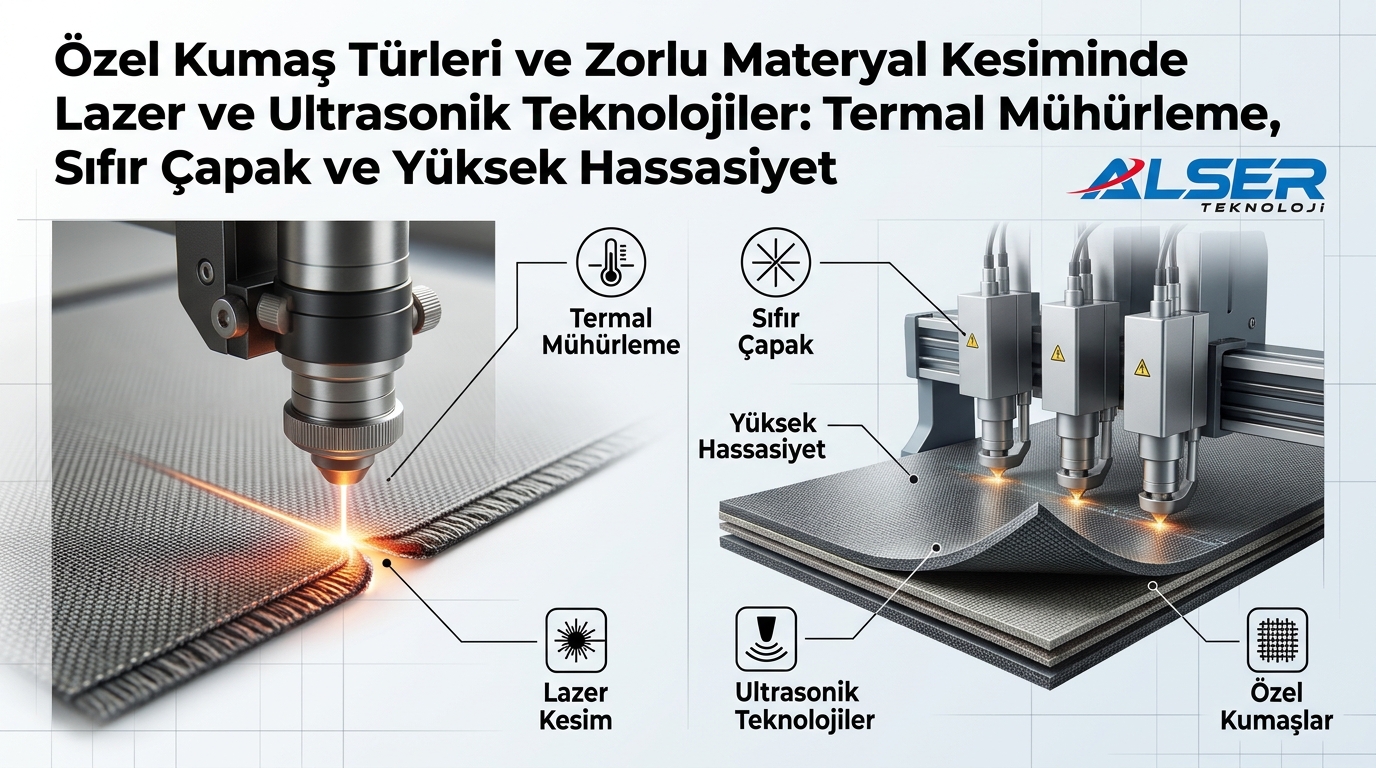
In textile, automotive upholstery, medical fabrics, and technical textile manufacturing, traditional mechanical cutting methods (such as blade or guillotine cutters) fall short as material diversity increases. Especially in difficult materials such as synthetic fibers, composite weaves, elastane blends, and high-strength aramid fabrics, issues like fraying, layer sticking, dimensional deformation, and blade dulling are major production bottlenecks. In modern manufacturing facilities, these challenges are eliminated through contact-free and high-energy solutions offered by Fiber and CO2CO_2CO2 Laser Cutting and Ultrasonic Cutting technologies. This technical guide examines the characteristic properties of difficult textile materials and the effects of laser/ultrasonic cutting parameters on process quality.
1. Difficult Materials and Technical Disciplines Encountered During Cutting
The thermal and mechanical responses of materials used in the technical textile world differ completely from one another:
-
Aramid and Kevlar Fibers: Mechanical blades wear out in a very short time on these fabrics, which have extremely high tensile and shear strength. High-focus CO2CO_2CO2 laser beams cut the fibers within microseconds without subjecting them to mechanical stress.
-
Polyester, Nylon, and Synthetic Weaves: The biggest advantage of laser cutting in synthetic-based fabrics is thermal edge-sealing. Since the laser cuts by melting, the fibers at the fabric edge fuse instantly, and the product absolutely does not fray during washing or use.
-
Composite Carbon Fiber and Glass Fiber Textures: Vacuum-table Laser/CNC systems are preferred to prevent layers from separating from each other (delamination) and to keep dust emissions under control in layered structures.
-
Spandex, Elastan, and Neoprene: Contact-free laser cutting performed without applying physical pressure on high-elasticity materials prevents the material from stretching or losing its form.
2. Optical and Gas Parameters in CO2CO_2CO2 Laser Cutting Technology
To prevent edge yellowing and burning in CO2CO_2CO2 laser machines used for cutting fabrics and soft materials, three fundamental parameters must be optimized:
-
Air Assist and Gas Pressure: Dry and oil-free compressed air sprayed from the cutting head extinguishes the flame on the cutting line, removes smoke, and prevents scorching/blackening on the upper surface of the fabric.
-
Pulse Frequency and Speed Balance: Modulated high-frequency pulses (PWM) are used instead of continuous wave (CW) for delicate lace, tulle, or thin synthetics. Thus, the Heat Affected Zone (HAZ) transferred to the material is kept to a minimum.
-
Honeycomb Table: Strongly suctioned vacuum tables are used to keep the fabric stationary during cutting and to prevent laser energy reflecting from the bottom from leaving burn marks on the back surface of the fabric.
3. Ultrasonic Cutting Technology for Precision and Thermally Sensitive Materials
-
Working Principle: A titanium or steel sonotrode (blade) vibrating at a frequency of 20 kHz – 40 kHz applies micro-impacts to the material thousands of times per second.
-
Advantages: It instantly melts and seals the edges using frictional heat; however, since it does not produce high heat like a laser, it does not leave hardening, yellowing, or a burning smell on the cutting edge. It is the most hygienic method for medical bandages and filter fabrics.
4. Multi-Layer Cutting and Automation with CCD Camera Systems
To increase industrial manufacturing speed, cutting machines are equipped with digital image processing technologies:
-
CCD Camera and Pattern Recognition: It detects shifts caused by fabric stretching in printed fabrics, sports jerseys, or plaid patterns using a camera. It cuts with zero tolerance by tracking the print lines instantly.
-
Automatic Spreading and Conveyor Feeding: Feeding rolled fabrics onto the conveyor table with tension control ensures an uninterrupted production line without human intervention.
Choosing the Right Technology for Efficient and Quality Production
Success in cutting difficult fabrics and materials depends on choosing the wavelength, correct air pressure, and appropriate table configuration suited to the chemical structure of the material. Proper optimization of laser or ultrasonic parameters reduces waste rates while maximizing edge quality and production capacity.